
When we think of trade wars, it is tempting to see them as fights between nations—China versus the U.S., Germany versus Southern Europe, exporters versus importers. But in their book Trade Wars Are Class Wars, Matthew Klein and Michael Pettis argue that what looks like a geopolitical conflict is actually rooted in something more fundamental: inequality within countries.
Globalization restructured economies in ways that shifted the balance between labor and capital, often leaving workers behind while capital owners benefited. The trade tensions we see on the surface are symptoms of these deeper domestic imbalances.
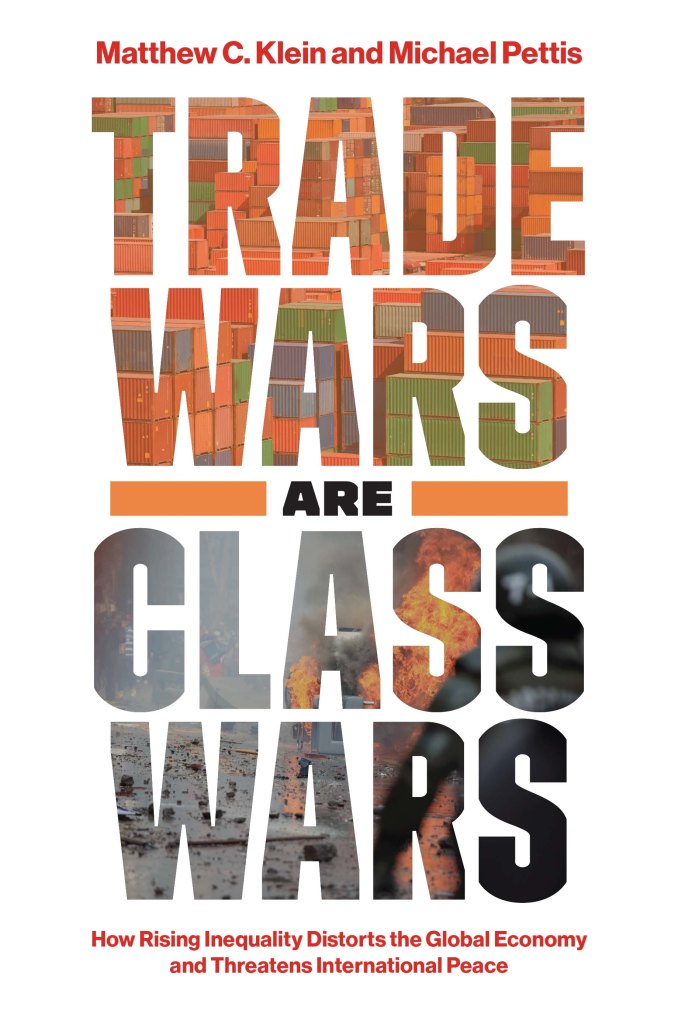
Trade Surpluses Reflect Weak Domestic Demand
A central thesis of the book is that when a country runs persistent trade surpluses, it is not simply because its companies are “more competitive.” Instead, it reflects something more troubling: its people lack the purchasing power to consume what they produce.
- In surplus countries like China and Germany, governments and institutions deliberately suppressed wages and household consumption in order to drive export-led growth.
- This resulted in huge trade surpluses and massive savings that had to be invested elsewhere in the world.
- Where did those savings go? Mostly into U.S. assets—Treasuries, stocks, property—fueling America’s deficits.
For the U.S., this meant running large current account deficits and absorbing global savings by expanding credit. Cheap financing boosted Wall Street and housing markets, but it also left the U.S. economy tied to foreign capital flows rather than its own fundamentals.
China’s Model: Growth Through Household Sacrifice
After opening up to the world, China needed to build its industrial capacity quickly. Instead of relying on volatile foreign capital, Beijing turned to its own citizens’ savings. But this required policies that effectively transferred income away from ordinary households toward the state and state-owned enterprises:
- High savings rates pushed by weak social safety nets and limited investment options.
- Financial repression, where bank deposit rates were kept artificially low, meaning workers lent money to banks (and then to state enterprises) at extremely low cost.
- Restrictions on migration and welfare access through the hukou (household registration) system, keeping rural workers cheaper and more dependent.
- Tax and regulatory systems that favored state-led investment over household consumption.
The result was a system critics often describe as “cutting leeks” (割韭菜)—ordinary workers’ income and pensions effectively subsidized the state, local governments, and politically connected enterprises.
By the 2000s, China had become the “world’s factory.” But workers could only afford to consume around 40% of what they produced, despite a household savings rate above 50%. The excess production had to go somewhere, and that “somewhere” was the global market—especially the United States.
The U.S. Role: Absorbing the World’s Imbalances
The flip side of China’s suppressed consumption was America’s willingness to consume more than it produced. Foreign savings poured into U.S. assets, strengthening the dollar, inflating asset prices, and weakening U.S. competitiveness in manufacturing.
This dynamic led to:
- Huge trade deficits, especially with China.
- Millions of job losses in U.S. manufacturing regions.
- Rising resentment that fueled the politics of protectionism and “America First.”
In this view, the U.S.–China trade war wasn’t just a conflict between two nations. It was a response to decades of global imbalances that were themselves created by domestic inequality within countries.
Why It Matters
Klein and Pettis urge us to stop thinking of trade wars as purely geopolitical struggles. Instead, they are tied to social dynamics within nations:
- In surplus countries (China), workers and households bear the cost of policies that suppress consumption to promote national competitiveness.
- In deficit countries (U.S.), working-class households lose jobs and income as foreign savings fuel asset inflation and financial concentration.
The “wars” are not really between the U.S. and China, but between workers and elites within each country. For example –
Imagine a Chinese worker who makes shoes. She can only afford to buy a small share of the shoes she helps produce, because her wages are low and her savings locked in banks earn almost nothing. The rest of the shoes are shipped abroad.
On the other side, an American family buys those imported shoes at Walmart. But the shoes are cheap partly because their own local shoe factory closed years ago—undercut by imports—and now they rely on credit cards or mortgage debt to sustain consumption.
Both workers, Chinese and American, are caught in the same system: policies that transferred income and stability away from them toward elites, whether China’s state enterprises or America’s financial markets.
Final Thoughts
Trade Wars Are Class Wars reframes globalization. Rather than a story of efficient trade benefiting all, it reveals how domestic inequality drives international conflict. China’s high savings and weak consumption, Germany’s wage restraint, and America’s deficit habit are not separate problems but interconnected pieces of the same puzzle.
The lesson is clear: Fixing trade wars requires fixing inequality at home. Without stronger wages, consumption, and protections for households, global imbalances will persist, and the cycle of resentment, tariffs, and financial instability will continue.
Reference
[zotpress items=”{5235677:K3JG68VF}” style=”apa”]
Leave a Reply